 07 3861 4677
 reception@mgisb.com.au

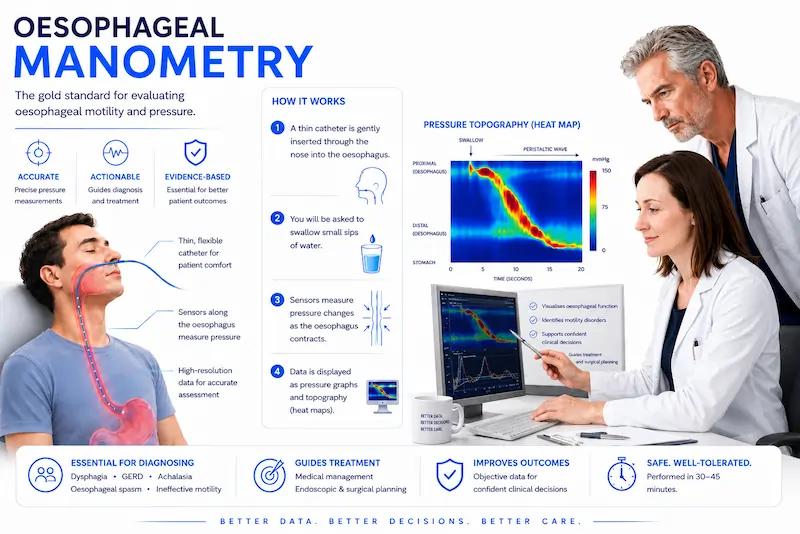
Having manometry is considered an essential test before many gastrointestinal (GI) surgeries. It helps to determine what surgery may be needed, your possible response to surgery, or if surgery is not the best option.
Oesophageal Manometry
Your oesophagus is a tube that transports what you swallow from your mouth to your stomach. Oesophageal Manometry is a test that measures how well the muscles in your oesophagus are working and can help determine the cause of your symptoms.
Why might I need it?
- Difficulty swallowing
- Food sticking after swallowing
- Reflux symptoms like heartburn, acid brash
- Chest pain of uncertain cause
- Aspiration pneumonia
- Before considering anti-reflux or similar surgery
- Review of symptoms after a past surgery
- It is also needed to accurately perform other tests, such as pH monitoring
What to expect
- You will be provided with fasting instructions and of any changes to routine medications before your test.
- Your nose will be numbed to improve comfort.
- A thin flexible tube (catheter) is passed gently through the nose into your oesophagus. This tube has lots of pressure sensors on it.
- You will be asked to swallow small amounts of water.
- You can breathe, talk and swallow normally during the test.
- The test takes around 20–30 minutes.
- Because you need to swallow, you have to remain awake for the test, without sedation. The numbing spray and experienced staff help you feel comfortable for the first few minutes of the test when the catheter is inserted and most people find it only briefly uncomfortable, and very manageable.
After the test
- The catheter is removed immediately.
- You can eat, drink, and resume normal activities.
- You can drive yourself home.
Your measurements will then be analysed and interpreted by our specialist doctors. We use the latest protocol and interpretation process to ensure your test is performed and reported using the highest standard.
If surgery is not recommended, we can give advice regarding the best management strategies to address your symptoms, that may include non-surgical interventions, medication, lifestyle, nutrition and therapies.
pH (Reflux) Testing
pH testing measures how often stomach contents reflux into your oesophagus, how long these episodes last, and whether they are linked to your symptoms.
During the test, you can record when symptoms occur by pressing a button on a small recording device. This allows us to match your symptoms directly with what is happening in your oesophagus.
The test can also assess how reflux changes when you lie down or recline.
Advanced testing (pH with impedance) can detect both acid and non-acid reflux, providing a more complete understanding of your condition.
Why might I need it?
- Persistent reflux symptoms
- Symptoms despite medication
- Assessment before or after surgery
It helps determine the cause of your symptoms and assess how well treatments are working.
What to expect
- After manometry, a different thin catheter is passed through your nose into your oesophagus and taped to the side of your face.
- The catheter is connected to a small recorder worn in a small bag with a shoulder strap.
- You will go home with the device in place and continue your normal daily activities.
- You can eat and drink as usual during the test.
- You will record your symptoms in a diary and by pressing a button on the recorder so the doctor can determine whether reflux is happening at the same time you have symptoms.
- The test typically runs for up to 48 hours.
- Our specialist nurse will make sure you are comfortable and understand what to do before you head home.
After the test
Once the test is complete, you can simply remove and dispose of the catheter (just like blowing your nose) and return the recorder to clinic. Your doctor will analyse the results and use these plus the manometry result to guide your treatment plan.